
Ensemble Bash's World of Percussion No. 18
Tunnel Tremolos | Simon Says | Remo Remembered | Copeland Comes Clean | Cymbal Surplus

Outside the sun is shining, spring has officially sprung, and the sun sets later each day.
What more could you want?
Oh, you’d like 8 minutes worth of semiquavers, did you say? With a side order of interviews, obituaries, sparkling conversation and a ton of cymbals in a warehouse?
It appears you’re in luck! Hurrah! … as that’s just what we have in store for you in this month’s newsletter. We’ve also thrown in notice of a couple of concerts that two of we basheurs are involved in, in case you feel like toddling along.
Shall we begin?
WoP#1
Stephen and Chris got together with our apprentice artists, Engin Eskici and Will Miles to record Simon Limbrick’s thrilling ‘Tunnel’.
This was originally written for the opening of the Channel Tunnel in 1994.
The plan was for us to play the piece whilst at the front of the train (ideally inside it, rather than strapped to the front), providing a sonic moment of release as it zoomed underneath the English Channel and burst into the open air.
Sadly, this proved impractical. But what a glorious idea.
We made this recording in the stunning apse of St Luke’s Church in Canning Town (deconsecrated in 1985, so we didn’t have to work around the congregation), home of the wonderful Newham Music, the award winning music hub for Newham.
Stephen did the video editing and sourced the wonderful visual imagery, while Engin did the audio mastering.
The long, slow crescendi of the opening, all delivered with 90mph semiquavers explodes into a thumping heavyweight central section, before drifting off and fading into the distance.
It’s quite a ride…
When we performed this at the Spitalfields Festival in 1999, The Times raved about it: “Tunnel was a fantastic descriptive display piece, the pulsing beats hurtling forward with propulsive rhythms or impossible shimmering sounds”.
We couldn’t agree more.
WoP#2

Ensemble Bash has been working with Simon Limbrick almost from the very start of our existence - his piece Drum Gods for four players with two drum sticks each (and no instruments at all!) was first performed at London’s South Bank in 1993 and we have performed it - without exaggeration - hundreds of times since.
As part of our occasional series of interviews with composers who we have strong connections to, we asked Simon to unload some of his thoughts about writing for percussion.
We’ve published that online conversation on our website, but here are a few snippets:
There is something about the physicality of playing percussion instruments, the tactile qualities involved, and the fact that the activity fits into some bigger context.
There is a sanctuary to be found in playing the low octave of a marimba or a resonant drum gently with the fingers. Playing softly and listening.
When I write for percussion, the range of sound-making is always the key to the piece being worth the further interest and development. It’s necessary to get the sound right, with the right strokes, sticks, leaves, a cactus tine.
Thanks, Simon! Do visit his website marimbo.com and play around with the boings and the bongs and the bells… (that sentence will make sense when you get there…).
WoP#3
The world of percussion lost a legend 10 years ago last month - a legend that most percussionists have never heard of, though we all know his first name.

Remo Belli, founder of Remo Inc., passed away 25th April 2016 and we thought it was worth just revisiting all that he did for drummers.
Along with his friend Roy Harte, he founded the shop Drum City in Hollywood, which quickly became a Mecca for all the leading drummers of the age - and many film stars who were also drummers, such as Gary Cooper, Marlon Brando, Joe Shmoe, Jackie Cooper, Mickey Rooney and Peggy Harper Lee.
But everything changed for him, and for the world of drums, in 1957.
Before that date, all drum heads were made of animal skins, which were subject to the vagaries of the weather and environment. A damp, humid atmosphere meant that the skins sank and sounded like hitting soggy handbags, too hot and dry and they took on a twangy, strangled sound, as well as risking breaking.
Noting the development of plastics after the Second World War, and seeing in Mylar the potential for an entirely new type of drum head, Belli started experimenting and in 1957 produced the Weather King - its name a nod towards its ability to be used in all types of weather.
This was transformational. It also meant that drums could be hit harder, there was scope for more experimentation in tuning, and the skins (we never stopped calling them skins…) were durable and long-lasting.
Ringo Starr stated that "thanks to Remo Belli, rock was born".
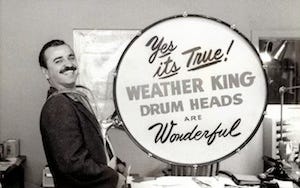
But he was more than an astute businessman. Though none of us ever met him, he comes across in interviews as a genuinely good person with a passion for transforming not just drumming, but human life.
"My dream is to put a drum in every household, not to make drummers, but to better the human condition. We seek to promote the awareness of rhythm as a tool for the maintenance and restoration of the physical, mental, emotional, and spiritual health of individuals and the community"
Another little nugget here is that in 1961, along with chemist Sam Muchnik, he created the then largest bass drum in the world for Disney, at a colossal 3 metres 20cm (10 foot 6 inches).
(Apparently it was that size because that was the largest sheet of Mylar that DuPont were able to create!)
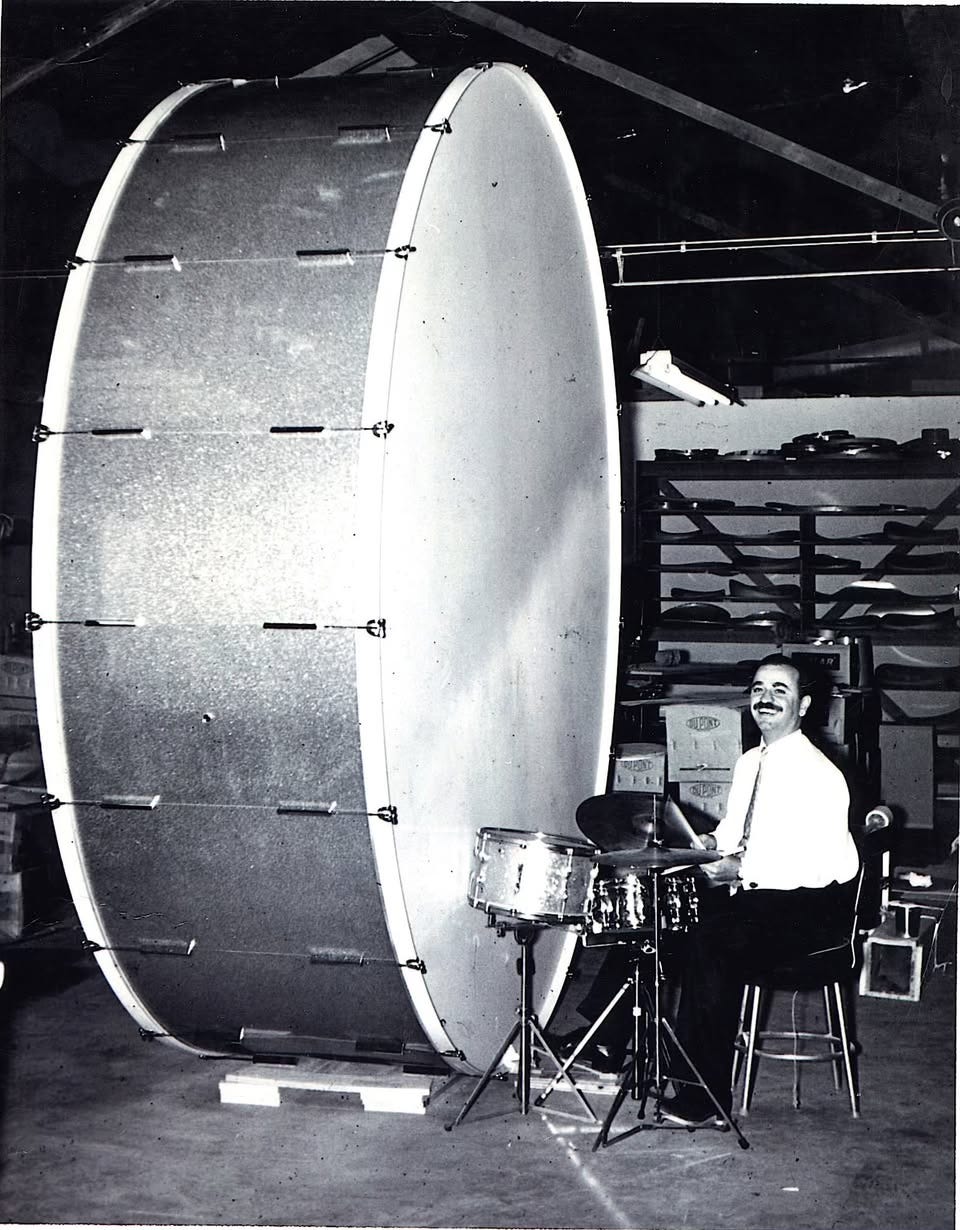
More about the history of Remo Belli and Remo Inc. here.
WoP#4
While we’re on the subject of nice, talented people, let’s return to a subject we’ve visited before, Stewart Copeland.
While we were drifting through the interweb recently, we found ourselves wandering through a series of interviews and just thought we’d like to share some of his musings.
In this first one, he talks about the reason for the tension in The Police - the fact that we all make music for different reasons: “I just want to bang stuff”, whereas for Sting, “if you’re a songwriter, you get this exotic idea that the purpose of the band is to serve the song”…
We can’t trace who this interview is with - can anyone identify him?
And now, talking to the wonderful Rick Beato, how he never knew the lyrics of The Police’s songs until he had to arrange them.
And finally the truth about ‘those’ fights and breaking Sting’s rib. Not quite as dramatic as we would have hoped, but funny nonetheless.
Last year, Stewart released his Wild Concerto, an album fusing orchestral composition with authentic animal sounds, recorded in the field by celebrated British naturalist, The Listening Planet’s Martyn Stewart.
Stewart said:
“This project is a culmination of everything I’ve learned as a film and opera composer. But instead of sopranos and tenors, I’m working with hyenas, wolves, and a chorus of birds. Their voices bring an unparalleled authenticity to the music.”
Worth a listen - there’s a link to a promotional single on the webpage.
WoP#5
What we’re listening to
We’ve featured the always wonderful Peter McGarr in WoP4 and WoP8 and he will feature - and we do not apologise - in the future.
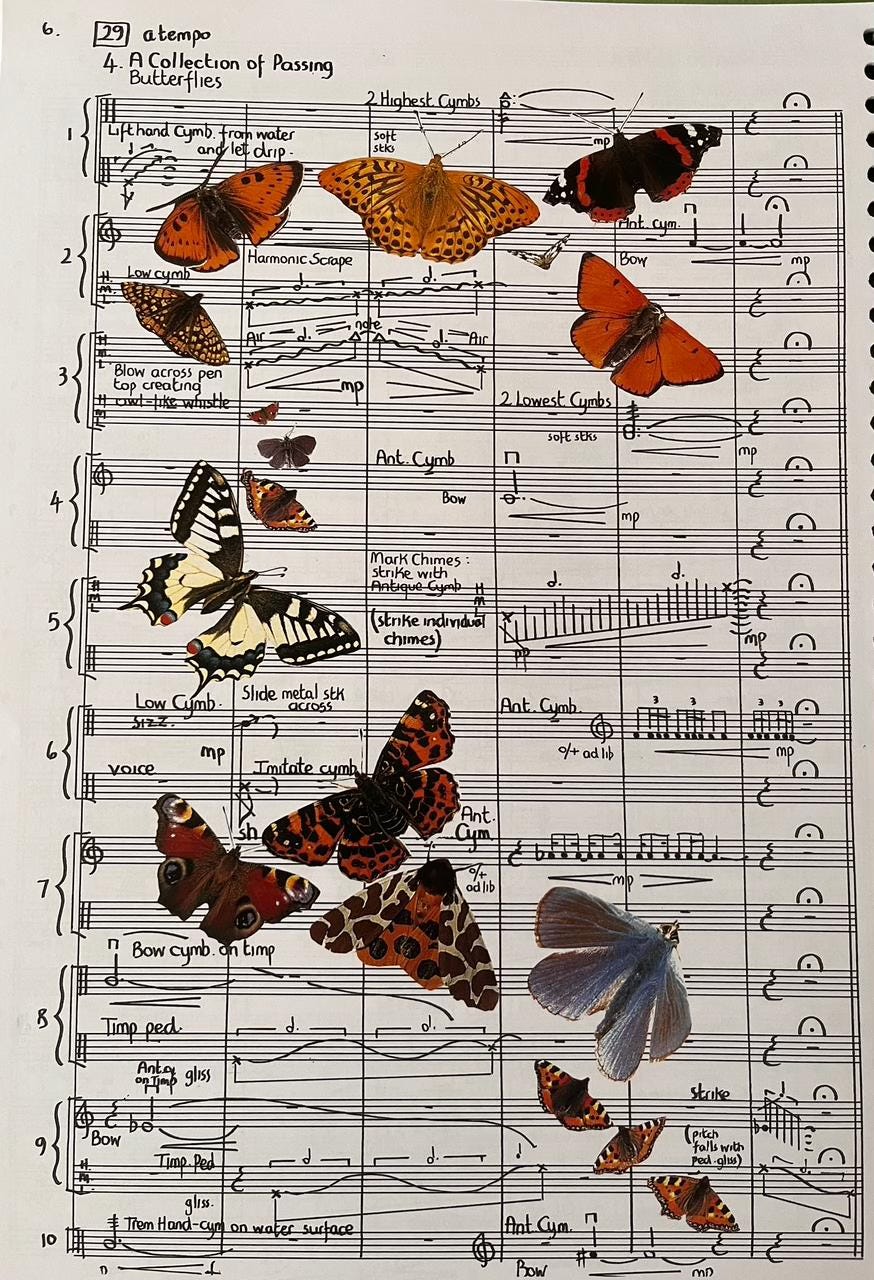
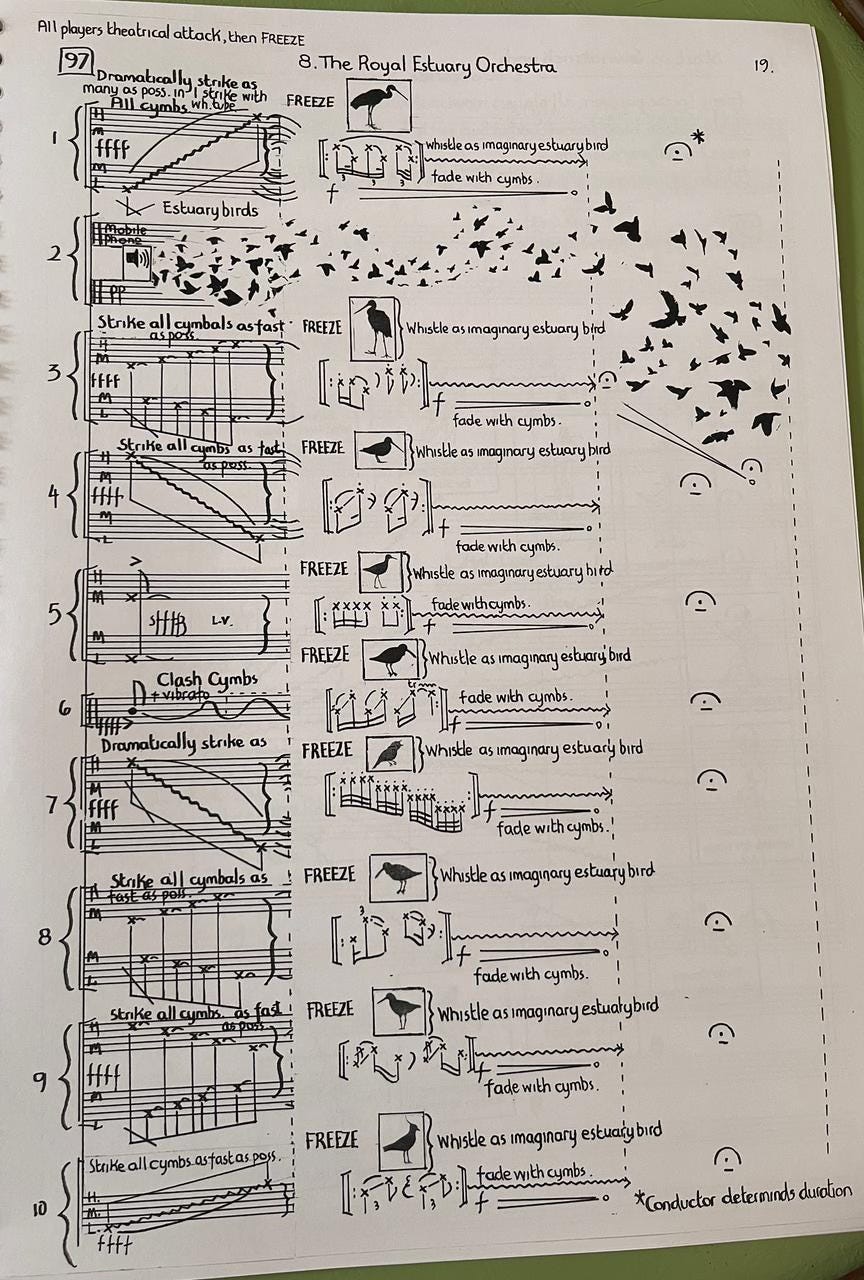
He recently dedicated a work to Richard, The Tides of Lune, for 100 cymbals (as well as a few other instruments).
Who else would be crazy enough to write for 100 cymbals, we asked ourselves?
It turns out that another composer, Ryoji Ikeda is.
Though this is only a teaser, it’s a lovely thing to listen to.
While we’re thinking of Peter, just take a look at some of the pages from the score of The Tides of Lune - pure magic.
Bonus WoP
It’s a little way off, but Richard will be playing vibes in Music for 18 Musicians by Steve Reich, with Colin Currie and musicians from the Guildhall School of Music & Drama. The New York Times described this work as ‘one of the ten most important of the 1970s, and it’ll be at the Barbican Centre on 2nd December. Tickets here.
And Stephen will be playing at the Acid Horse Festival in Wiltshire with Sarah Angliss in late May.
See you around!
Feel free to comment - we love reading your thoughts!
Follow us on Facebook here or on Instagram here.